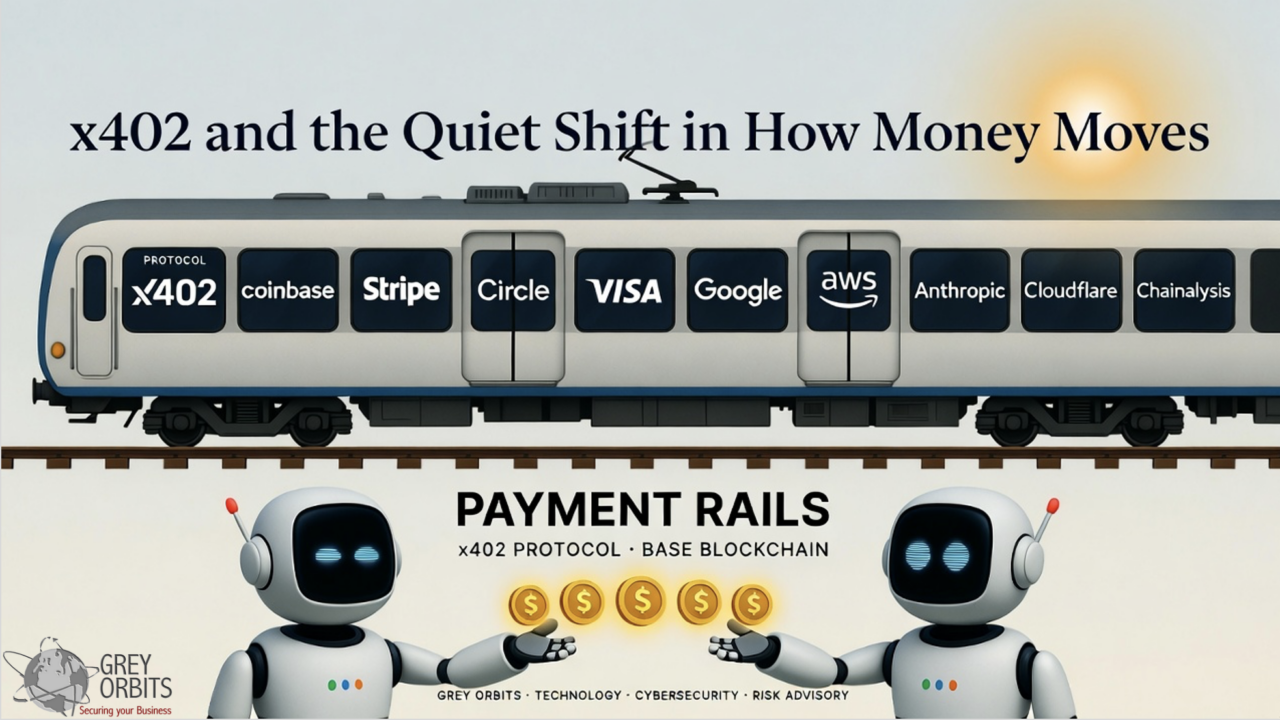
Visa took decades to scale. On the other hand, AI agents on a public blockchain have settled more than 100 million stablecoin transactions in just nine months.
In February 2026, I observed Stripe activating x402, an open standard for internet-native machine-to-machine payments, using USDC stablecoin. Three weeks later, I also observed Circle, the issuer of that USDC, confirming the exact same direction with nanopayments.
This month (June 2026), Chainalysis published on-chain data confirming what Stripe and Circle set in motion, signalling a wider shift across stablecoins, tokenised assets, blockchain infrastructure, and compliance practice. For anyone responsible for payments, treasury, technology, compliance, or strategy, that should warrant a serious look.
By way of context, this is the kind of material I cover in my modules on Blockchain, Digital Currencies, and Tokenisation within the Digital Finance and Fintech with AI programme at Singapore Management University. The wider programme spans AI and machine learning in finance, blockchain, financial data analytics, automation, and quantum readiness. My modules go deeper into the technology, business models, regulatory landscape, and strategic decisions senior leaders are now facing in blockchain and digital assets. If you would like to engage with the material in a structured setting alongside peers, registration is open here:
https://smu.emeritus.org/digital-finance-and-fintech-with-ai-programme-lf.
This briefing goes deeper into x402 and the Quiet Shift in How Money Moves.
What x402 actually is
For decades, online payments have been built around humans. You open an account. You log in. You enter a card number. You click confirm. Behind the scenes, banks and card networks verify your identity, batch transactions, and settle payments over hours or days.
This works for people. It does not work for AI agents that need to pay for things on their own.
Imagine an AI agent that wants to pull a credit report on your behalf, check a stock price feed, or buy a satellite image. Each of those services costs a small amount of money. The agent cannot stop and wait for you to type in a card number. It needs to pay at the same instant it asks.
x402 is a new technical standard developed by Coinbase Developer Platform, reviving one of the oldest ideas in web history: enabling native, built-in payments directly through the internet itself, by reactivating a long-unused HTTP status code, ‘402 – Payment Required’.
When an AI agent asks for something, the service replies with a price. The agent pays. The service delivers. The whole thing happens in less than a second. The payment is made in USDC, the dollar-pegged stablecoin issued by Circle. It moves on Base, a fast, low-cost public blockchain built by Coinbase that sits on top of Ethereum and inherits its security.
This is the whole idea. Not complicated. But quietly important.
Who switched it on
Stripe processes a large share of the world’s online payments. When they activated x402 in February 2026, it signalled to millions of developers that it was a real payment rail, not a research project. Circle is the issuer of USDC, the stablecoin used in most x402 transactions. When Circle activated its own x402 capability three weeks later, it sealed the loop. The dollars and the rails were both in place.
Both companies deserve credit. They did not wait for the protocol to mature. They moved first, knowing that whoever defines the early infrastructure shapes the market that follows.
What the numbers say
Chainalysis published its findings this month (June 2026). Over 100 million x402 transactions on Base in roughly nine months, growing from near-zero nine months ago. That is a real number.
There was a meme coin called PING that drove some early activity. People paid one USDC each time to mint a token. It looked like a slot machine. Critics will point to it, but when you do the maths, PING accounts for less than two per cent of total transactions. The volume that followed is mostly genuine usage.
Here is a point that is often misunderstood. Most transactions on x402 are now at least a dollar. That sounds like the protocol has moved away from micropayments. It has not. A one-dollar payment is still a micropayment. What has changed is that people stopped testing with sub-cent amounts and started using real ones. The micropayments have grown.
The other signals matter too. The share of users who tested the protocol and then went on to make real payments improved fourfold in six months. Weekly returning users are trending upwards. Wallets are being funded with real money. This is what early adoption looks like when it is working.
Chainalysis deserves credit here as well. They produced the first credible independent audit of the protocol. Without that kind of work, the rest of us would still be guessing.
The bigger picture
x402 is one piece of a larger shift. Chainalysis published a wider report this month called The New Rails. A few of its numbers are worth carrying.
Stablecoins processed twenty-eight trillion dollars of real economic activity in 2025. Projections put that figure in the quadrillions over the next ten years. Tokenised real-world assets (such as bonds, equities, gold, and real estate, issued on a blockchain) are approaching thirty billion dollars in assets under management. The choice of which blockchain to build on now matters as much as the choice of database once did. Bitcoin and Ethereum are settling into long-term settlement layers. Newer networks like Base and Arbitrum are the everyday rails. High-throughput chains like Solana and TRON are built for speed.
Compliance standards have hardened sharply. What was considered best-in-class in 2020 is now the average. There is one finding worth flagging for readers based in Asia. Compliance practices in this region remain more lenient than in Europe or America when it comes to monitoring indirect risk. That gap will close, but it has not yet.
The point is not that any one of these things will change finance overnight. It is that all of them are happening at the same time, and they reinforce each other. Stablecoins need rails. The rails need compliance. The compliance work needs data providers. The data providers attract institutional users. The institutions bring real money. Real money attracts more participants.
This is how infrastructure shifts happen. Quietly, in layers, until one day the old way looks dated.
What this means for you
If you work in financial services, payments, technology, risk, or compliance, the question is no longer whether to engage with this. It is what your role within it will be.
Some institutions are already on the curve. BlackRock, JPMorgan, Stripe, Circle, Mastercard, Franklin Templeton, Société Générale. They are not waiting for regulators to finish writing every rule. They are building, learning, and adjusting as they go.
Others will lag. Some will lag so badly that they end up settling on someone else’s rails, paying someone else’s fees, and following someone else’s standards. That is the real risk. Not getting it wrong. Getting it late.
If any of this has prompted a question you do not yet have a clean answer to, the SMU Digital Finance and Fintech with AI programme is built precisely for those questions.
Registration link again:
https://smu.emeritus.org/digital-finance-and-fintech-with-ai-programme-lf.
Sources
- Stripe’s Payment Intents API annoucement
- Circle Nanopayments launch on Testnet
- Chainalysis report on Agentic Payments
About the Author
Viren Mantri is a cybersecurity advisor and former senior technology leader across Standard Chartered, UBS, McAfee, and KPMG. After three decades at the intersection of technology, risk, and regulation, he now helps organisations cut through complexity and make better security decisions.
CC-BY Viren Mantri, 2026, licensed under a Creative Commons Attribution 4.0 International License.
Disclaimer: All views expressed here are entirely mine.