Summary
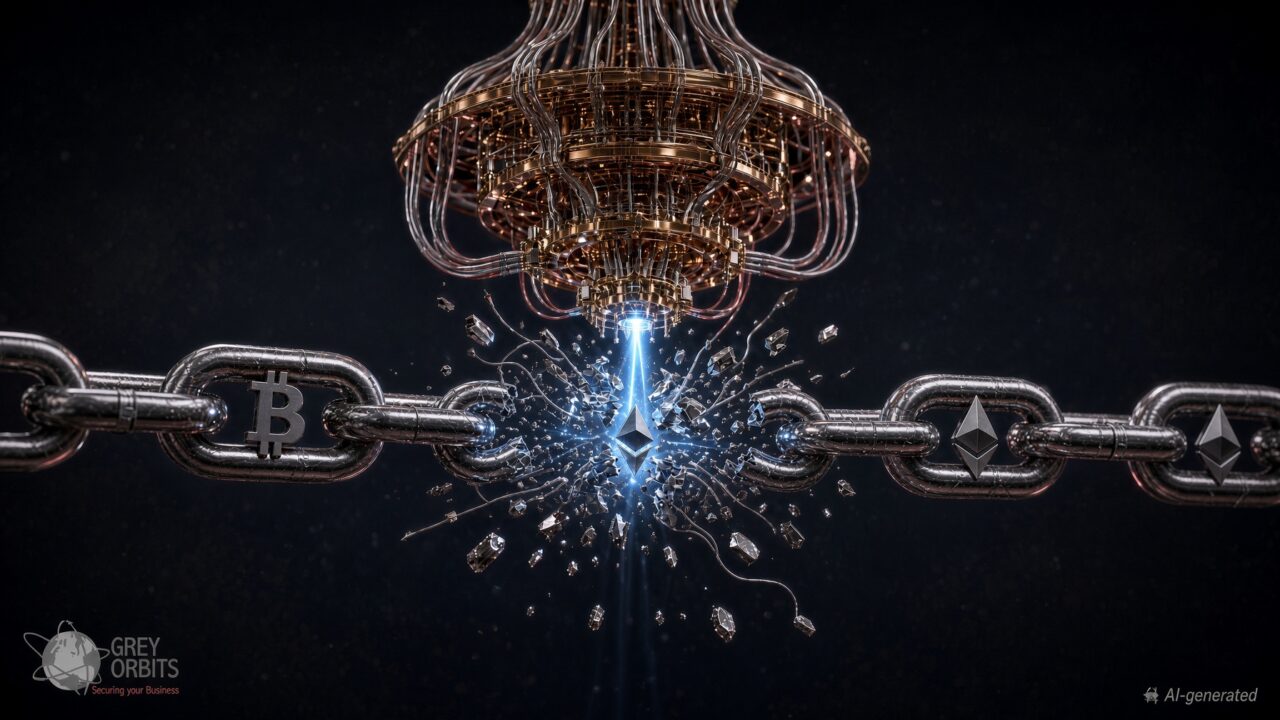
Three quantum breakthroughs published in one week in October 2026 have narrowed the gap between attacks on Bitcoin and Ethereum signatures and the hardware needed to execute them. Progress is unmistakable on both ends (circuit and hardware). As a newly joined senior instructor at Quantum Academy, I’m focused on a practical question: how should Bitcoin and Ethereum investors, both individual and institutional, track and prepare for Q-Day?
The short answer. Boards should ask custodians two questions; investors should review address hygiene. Both actions reduce exposure while waiting for chain upgrades.
The trigger, in brief
On 13 October, a Theta Labs engineer published a design reducing a key step in quantum attacks on Bitcoin and Ethereum signatures to fewer than 900 “logical qubits.” It remains theoretical; no quantum machine has run it. Check out Marin Ivezic’s (founder of Quantum Academy) informative article on PostQuantum.com [1].
On 15 October, Anthropic reported that its top model, Claude Mythos 5, outperformed published quantum circuit designs on seven of eight benchmarks and formulated a new approach on the eighth [2a, 2b]. The key point is the pattern: research that once took months now runs at machine cadence. On the same day, Google reported that it demonstrated “magic state cultivation,” a major quantum computing bottleneck, on real hardware, reducing errors about fortyfold [3].
The gap remains large: today’s biggest demonstrated quantum machines have fewer than 100 logical qubits, while the attack requires about 900. But the gap is shrinking at both ends. Back in March, I imagined this compression in “Year 2029: How Google’s Q-Day Warning Came True, Triggering a Confidence Crisis” [4].
What this means for institutional investors
Start with a basic fact that is often misunderstood. The quantum threat to Bitcoin and Ethereum is not a threat to the architecture your custodian has built. It threatens the maths Bitcoin and Ethereum themselves require. Your custodian cannot change that; the chains must upgrade first.
That said, there is substantial work your custodian can do today that does not depend on the chains. The choices that will determine whether your assets are protected on migration day are being made now, so, as investors, you should have visibility into how your custodian will continue to protect your assets post Q-Day.
Walk through the controls your custodian relies on currently. Cold storage. Multi-signature wallets. Hardware security modules (HSMs). Multi-party computation (MPC). Each protects you against theft, insider risk, and operational failure. None changes what gets published on the blockchain when your custodian moves your coins. What gets published is a signature using the current maths (called ECDSA), and a public key that a sufficiently large quantum computer can turn into the secret key. In other words, your custodian can split the key across many parties, keep it in a hardened vault, and never let a single person touch it, and the blockchain will still see an ECDSA public key the moment a transaction leaves.
This is not a hypothetical concern. A recent sector review in June captured the broader discomfort well: banks such as BNY and Standard Chartered are buying Bitcoin vaults, but a quantum problem may be waiting inside [5]. In September 2026, Mr Yehuda Lindell, Coinbase’s Head of Cryptography, acknowledged that MPC does not fit the most promising post-quantum signatures [6]. Coinbase has since published its priorities for Bitcoin’s post-quantum migration and is engineering a hardware security module fallback as a hedge for the roughly USD 250 billion it holds for institutional clients, including BlackRock [7]. Anchorage Digital has outlined a similar strategy [8].
The picture is a Catch-22, but only in part. Full migration depends on protocol upgrades that neither Bitcoin nor Ethereum has yet shipped. However, four workstreams are entirely in your custodian’s hands today, and asking about each is a legitimate part of your diligence.
- Post-quantum-ready hardware security modules (HSMs): store custodians’ cryptographic keys and can support multiple signature algorithms. Ask if yours are upgraded or when they will be.
- Quantum-resistant TLS protects encrypted channels within custodians, between servers, administrators, and clients. “Harvest now, decrypt later” is a real threat: adversaries capture sensitive traffic today and decrypt it when quantum computers become available. Custodians using TLS without post-quantum protection leave this traffic exposed.
- Testing post-quantum signatures. Running the leading candidates (two broad families: hash-based and lattice-based) in real custody workflows to understand performance and operational constraints before the chains ask for them.
- Address-type policy. On Bitcoin, some address types hide the public key until first spend; others expose it immediately. By enforcing one-time use and avoiding highly exposed types, custodians add meaningful defence while chains await upgrades.
A board should ask its custody provider two straightforward questions.
- Which of these four workstreams have you already deployed, and when?
- On the day Bitcoin or Ethereum accept a post-quantum signature, how fast can your signing stack switch? This is the crypto-agility question. It measures what the custodian can do with its own agency once the chains move. A credible answer is “within weeks”; a weaker answer is “we will tell you then”.
If a custodian answers either question with “we have Quantum Key Distribution, or QKD,” that is the wrong answer. QKD secures a private channel between two points; it doesn’t produce the public signatures a blockchain verifies. Treat it as a reason to probe further, not reassurance.
What this means for individual investors
A hardware wallet (Trezor, Ledger, or similar) keeps your Bitcoin or Ethereum secret key safe from laptop malware, but it doesn’t change the math behind your signature. Firmware may eventually add post-quantum support, but only after the protocols do.
Meanwhile, you can practice address hygiene, which depends on the address type. Three categories matter.
- Low exposure (hash-protected until first spend). Most modern Bitcoin addresses (P2PKH and SegWit) have hash protection that quantum computers cannot easily break. This protection lasts only until you spend from the address: then your public key is recorded on chain permanently. Bitcoin in a never-spent-from address is in the best position available today.
- Full exposure (public key already visible) includes three categories: the earliest Bitcoin addresses (P2PK), all Taproot addresses (newer “bc1p…” addresses, where the public key is the address), and any address you’ve spent from, regardless of type. Rough estimates put a quarter to a third of all Bitcoin in this bucket.
- Every Ethereum address that has sent a transaction permanently exposes its public key on the blockchain. Only addresses that have received funds but never spent them retain hash protection.
Practical actions, in order of priority
- Use a fresh address for each spend; reusing one doubles exposure. Modern wallets do this automatically, but verify yours does.
- Avoid Taproot for cold storage: its privacy benefits come with a full-exposure trade-off worth considering for significant long-term holdings.
- Watch for firmware updates when chains support post-quantum signatures. Individual holders will upgrade through wallet software, not through on-chain choices today.
- Follow Bitcoin Core’s BIP-360 discussions and Ethereum’s quantum-resistance roadmap. Both are progressing, but neither has shipped. The eventual defence will be a chain-level protocol upgrade, not a wallet upgrade.
You are not in immediate danger; however, addressing hygiene now reduces your exposure while you wait for a chain-level upgrade on Bitcoin and Ethereum.
Conclusion
Three quantum results published in one week. The compression is now happening at both ends. AI systems are optimising the attack side at machine cadence. The hardware side has just removed a resource bottleneck that researchers have been chipping at since 2004 [9]. The gap between the attack and the machine is still large but continues to shrink.
For institutional investors, the action is clear. Put the two questions to your custodian. Benchmark their answers against the public positions of Coinbase and Anchorage. If the answers are vague or lean on QKD, probe harder.
For individual investors, the action is smaller. Check your address types, use a fresh address for every spend, and watch for firmware and protocol updates in the coming year.
Nobody is in immediate danger; no one should be complacent either. The small moves made now will make the eventual migration easier when the chains open the door.
As I take up my new role at Quantum Academy, teaching these transitions is the day job. Translating them into actions that boards and individual investors can take this quarter is the point of articles like this one. Concrete steps exist on both sides of the custody line, and the next six to twelve months of monthly compression will tell us a great deal more.
Sources
- Marin Ivezic, A Key Step of a Quantum Attack on Bitcoin and Ethereum Now Fits in Under 900 Logical Qubits Within Google’s Gate Budget, PostQuantum.com, 14 October 2026.
- a. Andy Gu et al., Discovering State-of-the-art Quantum Circuits with Large Language Models (arXiv, 15 October 2026); Anthropic, b. Designing more efficient quantum circuits with Claude (Anthropic blog, 16 October 2026)
- Google Quantum AI, magic state cultivation on the Willow processor, 15 October 2026.
- Viren Mantri, Year 2029: How Google’s Q-Day Warning Came True, Triggering a Confidence Crisis, Grey Orbits, March 2026.
- Banks are buying Bitcoin vaults, but a quantum problem may be waiting inside, CryptoSlate.
- Mr Yehuda Lindell on MPC’s post-quantum limits, CoinGape, September 2026.
- Coinbase on Bitcoin’s post-quantum migration, The Block, 13 October 2026.
- Anchorage Digital, post-quantum preparedness strategy
- Mr Sergey Bravyi and Mr Alexei Kitaev, Universal quantum computation with ideal Clifford gates and noisy ancillas, arXiv:quant-ph/0403025, March 2004 (Physical Review A, 2005).
About the Author
Viren Mantri is the founder of Grey Orbits in Singapore, a Senior Instructor at Quantum Academy, and an Executive Faculty member at Singapore Management University Executive Development. Three decades across Standard Chartered, SC Ventures, UBS, McAfee, and KPMG inform his advisory work on AI, digital currencies, and quantum readiness. He authored the PETALS™ Framework for AI Governance, the Cybersecurity Model for Startups, and the Framework for Cyber Insurance.
© 2026 Viren Mantri, Grey Orbits. Licensed under a Creative Commons Attribution 4.0 International License.
Disclaimer: All views expressed here are entirely mine.