Cybersecurity Model for Startups
A practitioner methodology for building cyber resilience from day one of incubation.
The Problem
Founders building a startup operate under different pressure than established institutions. Speed beats comprehensiveness. Pivot beats process. Market validation beats anything that resembles overhead. From the inside, this looks like discipline. From the outside, particularly to the regulated incumbents these startups may one day partner with or sell into, it can look like recklessness.
The result is a familiar tension. Large regulated institutions view fintech startups as cowboys. The startups view the incumbents as overly conservative guardians, imposing multiple lines of defence that stifle growth. Neither view is entirely fair, and neither is entirely wrong.
Cybersecurity sits squarely in this tension. Phishing, ransomware, data breaches, and financial losses dominate headlines with no sign of slowdown. Boards, investors, partners, and customers increasingly ask hard questions before signing contracts. A startup that cannot answer those questions credibly will lose deals it could otherwise have won.
The instinct is to reach for marketing-grade cybersecurity language: zero trust, shift-left, defence in depth. These phrases are not wrong, but they are not where a founder should begin. The better starting point is plain language about what the business does, what threats face it, and what it would take to gain the full trust of the people whose belief is required to grow.
What This Model Is
The Cybersecurity Model for Startups is a practitioner methodology developed and applied across approximately twenty fintech ventures during my time as Chief Information Security Officer at SC Ventures, the venture-building platform of Standard Chartered Bank.
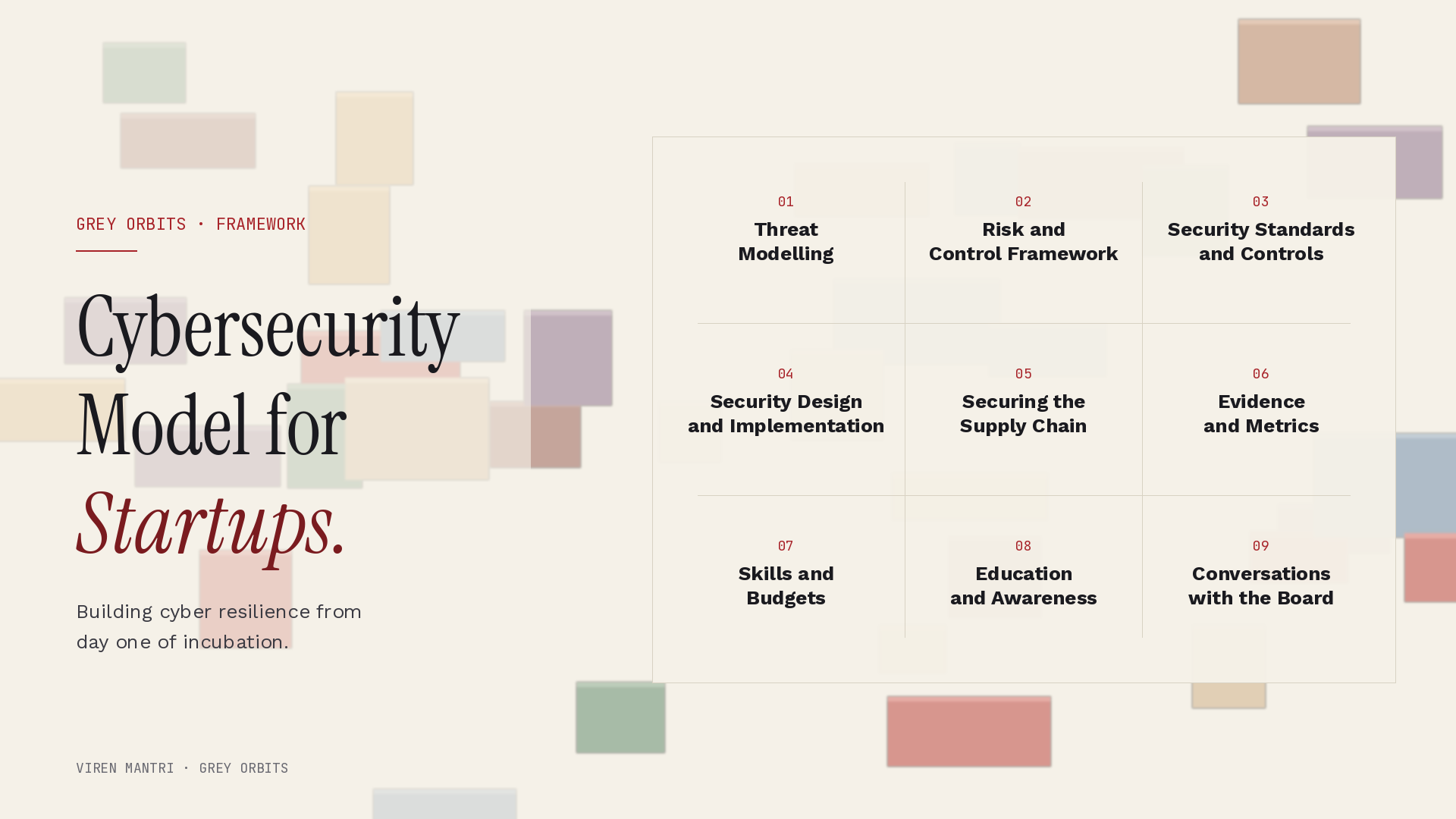
It is built around nine operational areas. Each area is a domain of cyber capability that a startup must develop, calibrated to its stage of maturity, capital position, and regulatory exposure. The model is not a checklist to complete. It is a structure for thinking, for sequencing, and for demonstrating credible cyber risk management to the audiences that matter — investors, boards, regulators, and customers.
The model is grounded in a single observation from Heather Adkins, Senior Director of Information Security at Google, drawing on her early days when Google itself was a startup:
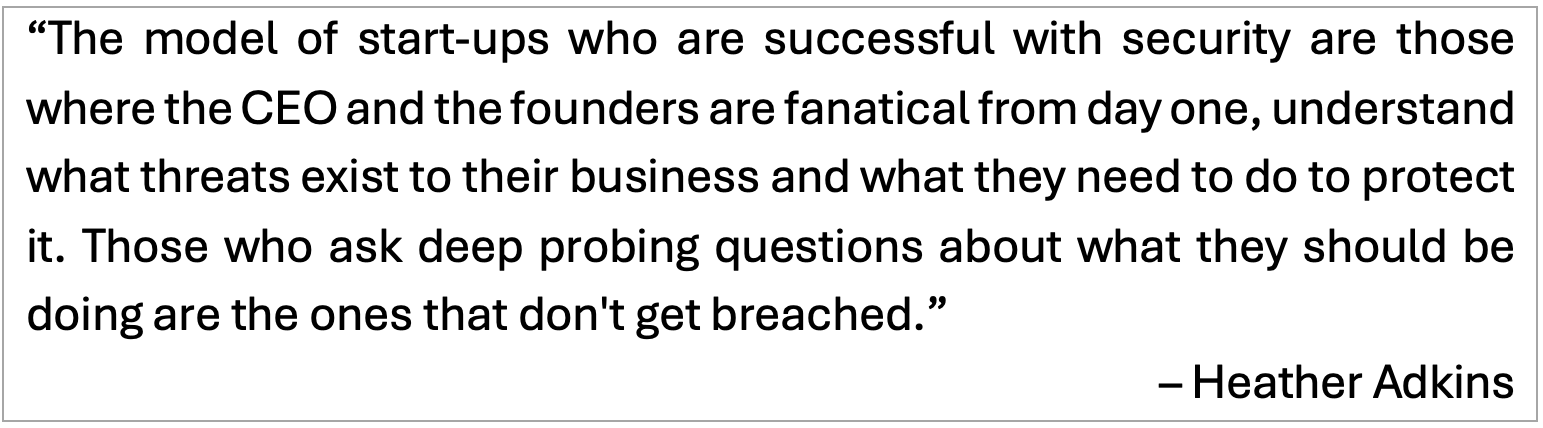
The model below provides the structure for asking those deep probing questions. It does not replace founder ownership. It enables it.
The Nine Areas
1. Threat Modelling
Threat modelling matters for every organisation. It matters more for startups, because startups pivot their plans rapidly and dynamically to test products and market acceptance. A minimum baseline of controls is necessary, but startups also need an approach for the progressive uplift of security as the business evolves.
The exercise begins with the business team articulating their business processes, the type of data involved, and the actors in each process. Cyber experts then assess the threat landscape driven by the nature of operations, assets held, and geographic presence. They identify the threat actors (insiders, competitors, criminals, terrorist groups, nation-state actors), the tools, techniques, and procedures these actors use (MITRE ATT&CK® is the canonical reference), and how events manifest as attack patterns: malware, denial-of-service, phishing, compromised credentials, web-based attacks, supply chain exploits.
Finally, the business team and cyber experts together assess the impact of each threat scenario — financial loss, data leakage, service disruption — and determine likelihood using threat intelligence sources such as FS-ISAC and the Verizon DBIR.
2. Risk and Control Framework
The word “framework” sounds excessive when applied to a startup. In practice it becomes a guiding beacon.
A Risk and Control Framework sets out the principles and standards for risk management not just for cyber risk but across all principal risk types: technology, operations, legal, compliance, financial fraud and crime. It establishes clear roles and responsibilities for ownership, oversight, and independent assurance. It encourages founders to think through risk appetite over different time horizons and to develop metrics and thresholds that clarify the criteria for risk acceptance.
A startup with no framework defaults to ad-hoc decision-making, which works until it doesn’t. A startup with even a lightweight framework can articulate to its board and investors how it makes risk decisions, which is what mature governance looks like.
3. Security Standards and Controls
Startups should not spend money or resources developing their own standards. Industry standards exist. They are mature. They map to one another. They are accepted by regulators.
The Center for Internet Security (CIS) controls are a strong starting point, with implementation groups that allow phased adoption. The NIST Cybersecurity Framework provides additional security objectives that organisations can reach at their own pace. CIS controls are mapped to and referenced by multiple legal, regulatory, and policy frameworks.
The threat modelling exercise above, combined with the risk appetite defined by the framework, drives the implementation of specific technical controls against identified threat vectors. The CIS Community Defense Model helps prioritise. CIS benchmarks, CIS hardened images, and CIS conformance packs accelerate implementation, bring consistency, and help demonstrate efficacy.
4. Security Design and Implementation
Most startups today are cloud-native. They do not sit behind four walls in the way on-premise organisations once did. Some provision endpoints and endpoint security for employees, contractors, partners, and customers. Some provision client hypervisors. Some operate hybrid cloud configurations.
Whatever the design, building in-house technical cyber expertise can be challenging as the founder navigates a broad spectrum of tools and services. The vendor landscape across identity and access management, software scanning, cloud infrastructure protection, vulnerability management, and runtime security is crowded. Evaluating and engaging managed services can accelerate the journey to a secure cloud, particularly in the early stages where in-house hiring is constrained.
Penetration testing and offensive security consulting, including bug bounty platforms, yield substantial benefits and provide the assurance that boards and investors expect to see.
5. Securing the Supply Chain
Most startups connect to other clouds, platforms, and services. Infrastructure as a service, platform as a service, software as a service. Each connection is a third-party trust decision.
Independent security assessment of third parties is imperative. This includes the professional and managed service providers engaged to deliver the services themselves. The assessment serves two purposes. First, due diligence to determine whether a third party is a good fit to do business with, supported by contractual agreements with legal and cyber schedules. Second, feasibility of implementing the specific controls required to integrate with the third party’s services.
Specialist vendors can assess third-party risk continuously. Standard due diligence includes reviewing certifications (ISO 27000 family, SOC 2), responses to questionnaires (Cloud Security Alliance Cloud Controls Matrix, Consensus Assessment Initiative Questionnaire), and participation in trust programmes (CSA STAR).
6. Evidence and Metrics
Efficacy of controls is demonstrated through evidence and agreed metrics that show risk and control maturity. Cyber risk can be quantified in dollars or in RAG status: Red for unacceptable, Amber for acceptable but requiring attention, Green for acceptable with no incentive for further reduction.
The business team and cyber experts jointly establish remedial plans of action for Red and Amber items, with timelines for progression toward Green, based on residual risk appetite. This is not a one-time exercise. It is the basis for ongoing board conversation.
A startup that can show its board a credible RAG view of its cyber posture has reached a level of governance maturity that materially affects how investors, partners, and customers perceive it.
7. Skills and Budgets
The importance of hiring skilled cybersecurity subject matter expertise cannot be overstated. Avoid mediocrity at all costs.
A technical generalist is not a cyber subject matter expert. Founders often conflate the two. In practice, the conflation leads to gaps that only become visible after an incident. The technical generalist may be the right person to build the product. They are rarely the right person to lead cyber risk management against credible threat actors.
The threat modelling exercise that clarifies the progressive uplift of controls translates directly into the progressive uplift of budgets required as the startup moves through its incubation stages. Hiring genuine cyber experts and making the budget available in line with threat models and residual risk appetite is one of the highest-leverage investments a founder can make. It allows the leadership team to focus on building the business with minimum likelihood of cyber incidents that consume time, capital, and reputation.
8. Education and Awareness
Acquiring cyber expertise is essential. Continuously educating the entire workforce is equally essential. This includes employees, contractors, partners, customers, and the board.
The most successful startups in the SC Ventures portfolio placed workforce education on cybersecurity as a top priority. Some proactively launched phishing campaigns to test employee awareness. Some integrated cyber education into focused group discussions with partners and prospective customers, building awareness of phishing, ransomware, and endpoint security threats as part of the relationship-building process.
Internal and contracted cyber experts were kept current on technical cloud skills and emerging threat vectors. The most mature startups recognised that education compresses incident response time, controls costs, and demonstrates a level of cyber maturity that becomes a competitive differentiator.
9. Board Conversations on Strategy and Cyber Maturity
Startups begin as ideas pitched for seed funding and become legal entities. From that moment, a team of risk experts (deliberately not called a “committee” in the early stages) should be regularly engaged to oversee cyber risk metrics alongside other principal risk types: technology, operations, legal, compliance, financial fraud and crime.
These metrics are pivotal to refining strategy and priorities with the board. They provide the assurance to the first set of customers and investors — early adopters and believers — that determine whether the startup survives its formative period.
The board conversation evolves as the startup matures. Pre-seed boards may discuss cyber as a single agenda item once a quarter. Series A boards may have a dedicated risk discussion at every meeting. By Series B or C, formal risk committees emerge. The Cybersecurity Model for Startups scales with the company.
How to Apply the Model
The model is most useful at three points in a startup’s incubation journey.
At founding and pre-seed, the model provides a framework for the founder to demonstrate cyber awareness to the first investors. It does not require expensive tooling or large teams. It requires structured thinking and the right early hires. Threat Modelling and a lightweight Risk and Control Framework are the priorities.
At seed and Series A, the model guides progressive uplift. Security Design and Implementation, Standards and Controls, and Securing the Supply Chain become operational concerns as the customer base grows and regulatory exposure increases. Evidence and Metrics start to surface in board reporting.
At Series B and beyond, all nine areas are operating at meaningful maturity. The board has formal risk oversight. Independent assurance is in place. The startup is now able to demonstrate cyber risk management to enterprise customers, regulators, and acquirers with the credibility expected of a mature institution.
Grey Orbits applies this model in three ways. Direct advisory to founders building cybersecurity from inception. Technology due diligence for investors evaluating fintech and emerging technology targets. Executive education for founders, boards, and venture-builders setting cyber expectations across portfolios.
The model is offered as a contribution to the discipline of building secure startups. It is the distillation of practitioner experience across approximately twenty fintech ventures spanning digital banking, cryptocurrency, and tokenisation. It continues to evolve as the threat landscape, technology stack, and regulatory environment shift.
A Closing Reflection
There is a reason this work matters beyond any single startup. Today’s startups are the institutions of tomorrow. The major technology platforms shaping the global economy were all startups once. The cybersecurity decisions made in the earliest years of a company compound, for better or worse, over its entire lifecycle.
A startup that treats cybersecurity as a constraint imposed by guardians will fight it for years and eventually pay the price. A startup that adopts the Heather Adkins model — fanatical from day one, asking deep probing questions about what they should be doing — earns the trust of every audience that matters. Boards. Investors. Partners. Customers. Regulators.
The Cybersecurity Model for Startups is the structure for asking those questions in a way that produces answers.
Sources and Further Reading
Standards and Frameworks
- Center for Internet Security (CIS) Critical Security Controls
- CIS Community Defense Model
- NIST Cybersecurity Framework
- MITRE ATT&CK
- Cloud Security Alliance Cloud Controls Matrix
- Consensus Assessment Initiative Questionnaire (CAIQ)
- CSA STAR Registry
Assurance Frameworks
Threat Intelligence Sources
Foundational Reference
Related Grey Orbits Frameworks
This model is offered under a Creative Commons Attribution 4.0 International Licence. Practitioners and educators are welcome to reference and adapt it, with attribution to Grey Orbits and a link back to greyorbits.com.
The quote from Heather Adkins is reproduced from her remarks at the How to Build a Secure Startup without Slowing Growth talk, used here under fair use for editorial purposes.
For advisory engagements applying this model to your venture, portfolio, or programme, contact support@greyorbits.com.
CC-BY Viren Mantri, 2022.
Disclaimer: All views expressed here are entirely mine.