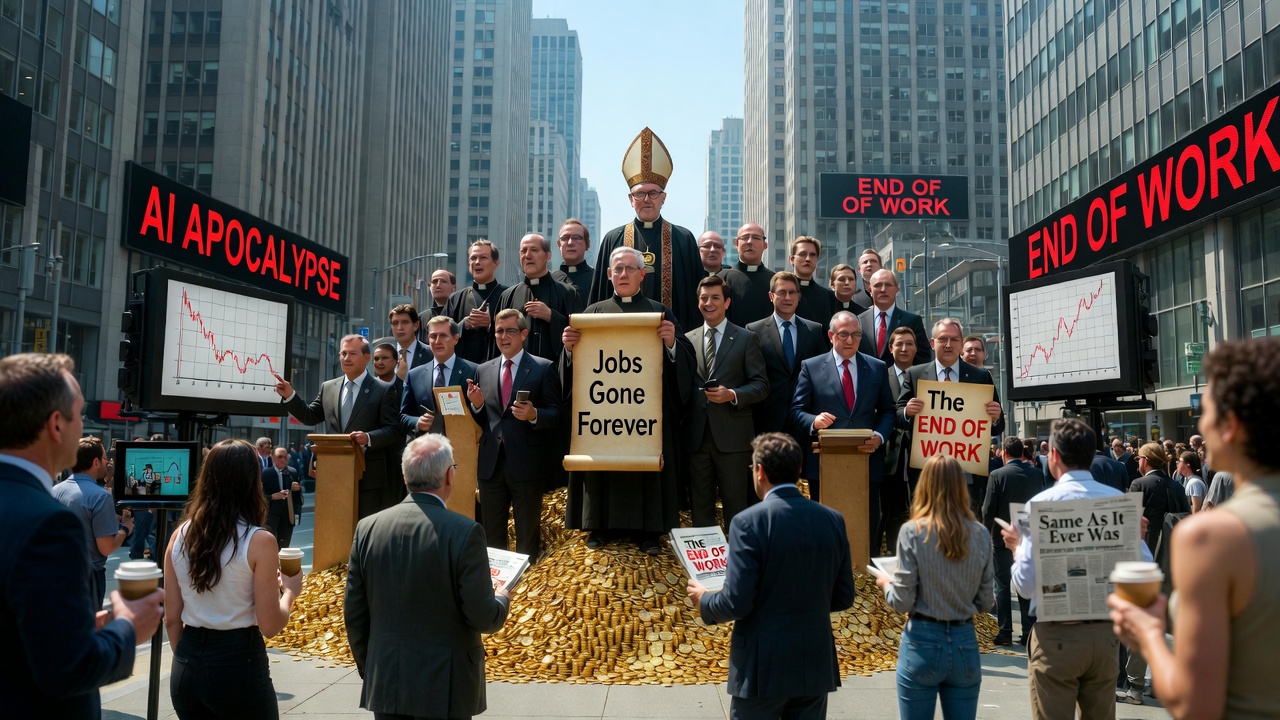
Dario Amodei says AI will wipe out 50% of entry-level jobs within five years. Elon Musk says no job will ultimately be safe. Sam Altman wrote that the price of labour would fall “towards zero”.
Well, the sky has been falling since the printing press. It is still up there.
Three billionaires. Three prophecies of doom. All three with cap tables that get fatter every time you believe them. They are not forecasters. They are founders.
I was reading Scott Galloway‘s recent piece “Apocalypse No” (Prof G Media, May 2026) this morning. It calls the AI job apocalypse narrative what it is: BS. And backs it up with data. And it reminded me of an old essay by David Graeber. “On the Phenomenon of Bullshit Jobs,” published in Strike! Magazine in 2013, later expanded into his 2018 book Bullshit Jobs: A Theory. Then Marin Ivezic ‘s writings on Organisational Bullshit. And then, somehow, of Dilbert.
I had read all of them before. Galloway brought it all back this morning.
A Promise That Was Never Kept
In 1930, John Maynard Keynes predicted that technology would advance so far that by century’s end, people in wealthy countries would work just 15 hours a week. He was right about the technology but spectacularly wrong about everything else.
Instead of working less, we worked more. And to justify all that extra time, we invented jobs. Whole new categories of them. Compliance officers overseeing compliance officers. Consultants hired to explain what the last consultant recommended. Middle managers managing other managers.
Anyone who worked in an office in the 1990s already knew this instinctively. Scott Adams, who passed away in January 2026, had the sharpest eye for corporate absurdity of his generation. Whatever one thinks of the man in his later years, the strip remains a near-perfect document of the bullshit workplace.
Graeber, who we lost as well far too soon when he died in 2020, gave the same phenomenon a proper academic name in 2013: Bullshit Jobs. His argument was that this was not accidental. The system evolved to keep people occupied, anxious, and too tired to ask difficult questions. A happy population with genuine free time, he wrote, is a political danger.
Ivezic spent years studying what this does to organizations. Bullshit, he found, suppresses critical thinking, erodes trust, and disengages the very people doing the work. Not as a side effect. As a feature. His more recent research, Science Confirms What Large Corporate Survivors Already Knew, confirms the damage is structural: bullshit drives out the analytically sharp and rewards those who cannot tell the difference between vision and vapor.
The Prophets Have Cap Tables
This is not a new story. It is a very old one with a much larger PR budget.
As Galloway puts it, the AI job apocalypse is not a forecast. It is a marketing strategy. Fear is the product. Capital is the outcome.
There is a useful distinction here, one that Ivezic draws on in his writings on organisational bullshit. It comes from Princeton philosopher Harry Frankfurt. A liar knows the truth and works to subvert it. A bullshitter does not care about truth at all. The only thing a bullshitter cares about is whether you will listen. By that measure, the prophets of AI job destruction are not lying. They are doing something more corrosive. They are indifferent to whether they are right. Ivezic further warns that AI makes this worse, trained on decades of corporate speak, it is essentially a bullshit generator by architecture, producing more polished and harder-to-detect nonsense at industrial scale.
Galloway also draws on Nobel economist Robert Shiller, who calls this broader pattern narrative economics. The fear spreads. People stop spending, stop hiring, stop investing. The downturn that follows gets blamed on the machines rather than the panic. Every major technology wave has triggered this loop. We are close to running it again.
The Jobs We’ll Lose Were Already Hollow
Here is where Galloway and Graeber collide and something sharper falls out.
A large share of the jobs most at risk from AI are precisely the ones Graeber documented as bullshit. The 90-page compliance report nobody reads. The three-layer approval chain for a two-paragraph email. The meeting to plan the meeting.
AI is going to vacuum up tasks that were already hollow. That is not necessarily a crisis. It might, in a strange way, be a correction. The real question is what fills the space. Do we use it to do more meaningful work? Or do we invent a fresh generation of bullshit to justify our calendars and preserve the hierarchy?
History is not reassuring on this point. Ivezic makes one observation worth sitting with here. Even when an organization and everyone in it is comfortable with the bullshit arrangement, the value generated is still sub-optimal. Someone outside the arrangement always pays. A Cornell study Ivezic further references found that people who fall for corporate bullshit score lower on analytical thinking and make demonstrably worse decisions. The flywheel drives out the sharpest workers and promotes those who cannot see through it.
Meanwhile, In the Real World
Galloway pulls data that most headlines skip over.
US tech employment grew from 8.7 million in 2020 to 9.6 million in 2023 and has been roughly flat since. Not a bloodbath. Flat. Meta’s layoffs returned the company to its 2021 headcount. Microsoft’s cuts would bring it back to 2022 levels, still 47% above pre-pandemic size. Tesla announced headcount growth in March and laid off 10% the following month, apparently without noticing the contradiction. Tech unemployment is converging toward the Fed’s target of 4%.
Terrifying stuff. Ivezic would recognise this immediately. Rebranding a correction as a transformation is organisational bullshit operating at corporate scale. Ivezic further notes that when companies ask AI to draft executive updates, the default output gravitates toward exactly the kind of impressive-sounding, semantically empty language that fools the most people.
It Was Never Really About the Jobs
The AI jobs panic is a wealth inequality story wearing a technology costume.
Galloway’s research shows that AI is viewed as a net positive almost exclusively by households earning above $200,000 a year. Everyone else sees a threat. That gap is not a reflection on AI. It is a reflection on who captures the gains and who absorbs the disruption.
Graeber saw this dynamic in 2013, long before anyone was talking about large language models. The system, he argued, was never consciously designed. It emerged from decades of trial and error to keep people working, anxious, and aiming their resentment sideways rather than upward.
AI is the latest chapter. The characters are just richer and the PR budgets are considerably larger. Ivezic observed that when people see through the narrative but choose to stay silent, they become accomplices to it. That dynamic, playing out across entire economies, is exactly what keeps the cycle running. Research Ivezic cites found that the more employees identify with their organisation, the more bullshit they accept and perpetuate, belonging and bullshit, it turns out, travel together.
How Not to Get Fooled Again
No one knows what 50% of jobs will look like in five years. Amodei said it would happen. His company’s valuation depends on you believing it. Musk predicted full self-driving by 2017. Altman sells the very thing he says will make labor worthless. These are not neutral observers. They are founders with cap tables.
Build skills that travel across waves. Judgment above all. The ability to ask the right question. The ability to recognise when a narrative, however confidently delivered from a stage in San Francisco, is bullshit.
Ivezic’s framework for dealing with organisational bullshit starts with recognition. Look for abstract language, confident forecasts without evidence, and decisions driven by personal agendas rather than data. Healthy cynicism, he argues, is not pessimism. It is a professional obligation. His advice for the AI era: audit AI outputs with the same skepticism you would apply to a junior consultant’s first slide deck. If it sounds impressive but you cannot explain what it means, it is probably bullshit, whether a human or a machine produced it.
Yes, disruption is real and some of it will hurt. But it is not the extinction-level event the people selling you this story need it to be. Stop outsourcing your anxiety to people with a financial interest in it.
Keynes wanted us working 15 hours a week by now. Instead we got compliance officers overseeing compliance officers and three billionaires competing to frighten us most. Adams saw it coming. Graeber named it. Ivezic told us what to call it. The rest of us are still sitting in the meeting to plan the meeting.
#AI #FutureOfWork #ArtificialIntelligence #BullshitJobs #Leadership #CriticalThinking #AIJobs #TechLayoffs #AIHype #NarrativeEconomics
Sources
- Scott Galloway, “Apocalypse No,” Prof G Media, May 8, 2026
- David Graeber, “On the Phenomenon of Bullshit Jobs,” Strike! Magazine, August 2013
- David Graeber, Bullshit Jobs: A Theory, Simon & Schuster, 2018
- Marin Ivezic, “Organizational Bullshit: The Hidden Corporate Menace,” postquantum.com, 2021
- Marin Ivezic, “We Need to Free Organizations of Bullshit,” postquantum.com, 2022
- Marin Ivezic, “Science Confirms What Large Corporate Survivors Already Knew: Organizational Bullshit Makes You Worse at Your Job,” postquantum.com, 2026
About the author
Viren Mantri is a cybersecurity advisor and former senior technology leader across Standard Chartered, UBS, McAfee, and KPMG. With 30 years of navigating the intersection of technology, risk, and regulations, he now helps organisations cut through complexity and make better security decisions.
CC-BY Viren Mantri, 2026, licensed under a Creative Commons Attribution 4.0 International License.
Disclaimer: All views expressed here are entirely mine.