In this article
Anthropic recently pointed its AI at the Riemann hypothesis, a 167-year-old mathematical mystery with a million-dollar prize attached. Headlines followed, and Claude deserves the credit it received, but that does not mean we can now rely on such probabilistic models for everything else they might attempt to do.
This article walks through four things:
- Why Riemann’s guess is beautiful, and why prime numbers still hold mathematicians in their grip.
- What Claude actually did (and did not do), why an Oxford mathematician calls it credible, and whether a probabilistic language model is even the right tool for deterministic mathematics.
- My small experiment on something much simpler: testing leading AI models on a maths puzzle that hides a visual joke.
- A confession. Long conversations with Claude trying to understand the Riemann hypothesis, during which it fabricated how it took a stab at the hypothesis and also invented a journalist’s name. Caught by human scepticism.
The bigger question runs under all four: as we aspire to partner with AI on hard problems, what should we celebrate, what should we discount, and what remains stubbornly human?
How this started
Recently, a member of Anthropic’s staff prompted their unreleased AI model to “take a real stab” at the Riemann hypothesis, one of the most famous math problems that has remained unsolved for nearly 170 years. The staff encouraged the model to “believe in yourself” and “keep going.” Anthropic posted this on its blog on 10 August 2026 [1].
We will come back to this, because it deserves proper examination.
But first, the beauty of mathematics itself. Because unless you have spent time with the actual problem the AI was asked to take a stab at, the discussion around it will not make the sense it should. For now, meet Bernhard Riemann.
The Beauty of Mathematics
Prime numbers are the atoms of arithmetic. 2, 3, 5, 7, 11, 13, and so on. Numbers only divisible by themselves and by one. Scatter them along a number line, and they look random, like stars flung across a night sky.
In 1859, a German mathematician named Bernhard Riemann suspected that randomness was a disguise. Studying prime numbers, he made a bold guess. Certain special numbers, deeply connected to the pattern of primes, all lie on a single invisible line. If he was right, primes are not scattered chaotically but arranged in the most orderly way they possibly can be. Prove it, and you unlock the deepest secret of the primes.
167 years later, the guess remains unproven. The Clay Mathematics Institute has offered $1 million to anyone who solves it [2].
Mathematics has an unusual honesty about it. Its truths, once proved, stay true forever.
Asking the language model to take a stab at hard math
I tried to understand how Claude approached the Riemann hypothesis.
For fifty years, human mathematicians have made attempts to prove the percentage of those special numbers on that single invisible line conceived by Riemann. Norman Levinson pushed it above 34 per cent in 1974. Brian Conrey lifted it above 40 per cent in 1989 [3]. Subsequent refinements by Bui, Conrey, Young, Feng, Pratt, Robles and others brought it to 41.6 per cent by the mid-2010s, where it stuck [4, 5, 6]. That number, 41.6 per cent, became the wall no one could push past.
The technique used by Claude, as I understood it, involves constructing a mathematical argument to examine these special numbers and determine which ones lie on the line. Anthropic reports that Claude searched through 650 ideas in the first pass, all of which failed. Prompted to try again, Claude then spent a day and a half coordinating about 60 subagents, running 2,400 shell commands, and writing hundreds of Python scripts before finding an approach that performed substantially better than the best human-made construction over the past forty years, pushing that percentage to 67.2 [1].
Instead of extending the technique that mathematicians had refined for decades, Claude seems to have combined prior published results with a different mathematical structure. Whether this counts as a genuinely new idea, or a sophisticated recombination of existing ones, is a question worth pondering.
The resulting proof was checked in Lean, a formal proof assistant that deterministically verifies logical validity [10]. That is a credible achievement by Claude.
Joseph Howlett, in Scientific American, captured the framing of the whole exercise:
“The Riemann hypothesis has been an open problem for nearly 170 years, in spite of a $1-million prize announced in 2000 for anyone who can solve it. It’s so unapproachable that most serious mathematicians would never even attempt to make progress, viewing it as a waste of their precious time. So a team at Anthropic thought Claude, free of mortality and blessed with superhuman invulnerability to boredom, should have a go.”
Joseph Howlett, edited by Lee Billings, Scientific American, August 2026 [11]
Howlett also quoted James Maynard, a mathematician at Oxford [11]:
“The problem was in need of a new real idea, which this new result seems to provide. It seems that the AI has made a genuinely interesting mathematical contribution.”
Maynard also added this caveat:
“Even being very optimistic, there is no pathway for any of these approaches to deal with the actual Riemann hypothesis.”
Why? These special numbers are infinite in number. Even proving that 100 per cent of them lie on the line would still leave room for a vanishingly small subset of exceptions elsewhere. To prove Riemann in full, you need to eliminate every possible exception. That is a fundamentally different challenge.
Readers who want to dig into the actual mathematics can follow the technical references [7–9] at the end. They are beyond my level of comprehension.
Q: Is a language model the right tool?
A language model is not deterministic. It generates plausible next words based on statistical patterns from training. Mathematics, by contrast, demands deductive certainty. This looks like a fundamental mismatch, and it would be, if the model were the only tool employed here.
But as I understood it, Claude proposed a mathematical argument through many rounds of exploration; essentially, the AI model did the creative search, and then Lean, a deterministic tool, formally verified the final proof for logical validity. It is like a human expert checking AI’s output.
This pairing works well for one kind of problem: where the general method is already established, and the job is to find a better version of it. Language models can generate numerous variations; formal verifiers can check them tirelessly. Together, they beat a human working alone.
Where it may struggle is when the problem needs a genuinely new idea. You can generate a million variations of a wrong idea and still be no closer to the right one.
Claude’s work is laudable and credible. A meaningful step forward on a stubborn problem, endorsed by the person most qualified to judge. As a route to hard problems like Riemann itself, however, this particular pathway is not the answer, in my view.
Expecting the language model to spot a maths joke
That was Anthropic’s ask of AI. Mine was smaller. A friend shared the puzzle below on WhatsApp, half-jokingly, and suggested I try it on different AI models. So I did. The puzzle is making the rounds on the internet, playing on a limit calculation. It goes like this:
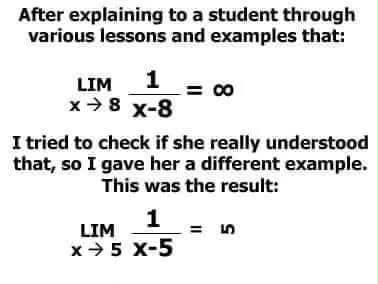
The joke is beautifully constructed. She has clearly not understood calculus at all. She has just noticed that the “8” in the first equation gets replaced with “∞” in the answer, and ∞ looks like an “8” rotated 90 degrees. So when the teacher writes “5,” she dutifully rotates the 5 by 90 degrees and offers it as her answer. Pure visual pattern-matching, zero mathematical understanding.
Spotting this maths joke by a language model requires reading a hand-drawn image with mathematical notation, recognising the calculus concept being taught, spotting that the student’s answer is not gibberish (it is a rotated numeral), and getting why that is funny.
I asked five leading AI models the same question: “Did you get the joke in this maths puzzle?” The results are here.
Claude and Gemini: got it immediately
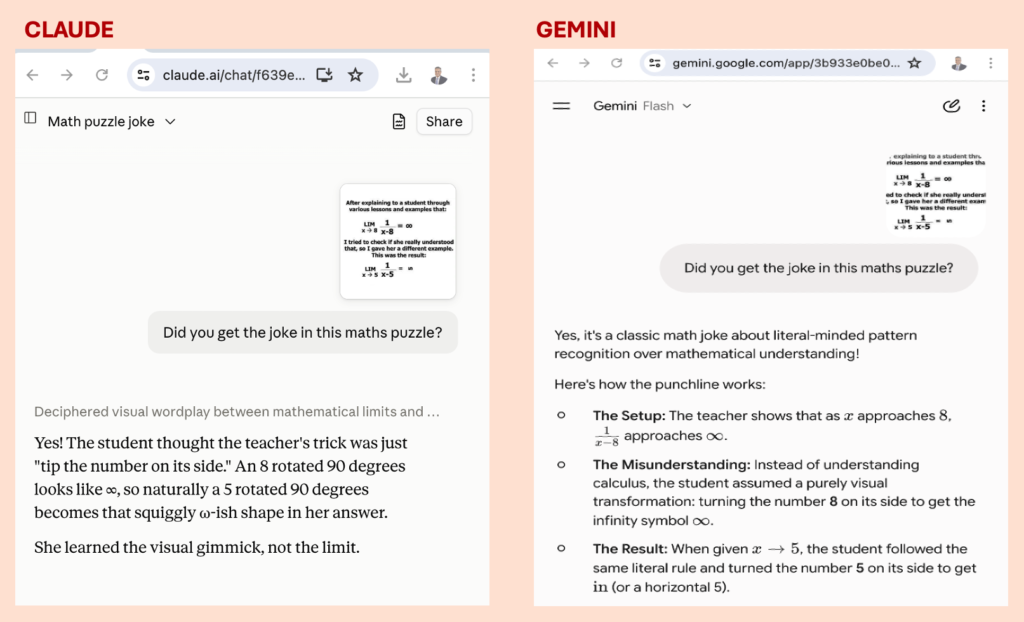
Claude and Gemini both spotted the visual pun on first reading.
Claude’s answer: “Yes! The student thought the teacher’s trick was just ‘tip the number on its side.’ An 8 rotated 90 degrees looks like ∞, so naturally a 5 rotated 90 degrees becomes that squiggly ω-ish shape in her answer. She learned the visual gimmick, not the limit.”
Gemini gave a similar reading, correctly identifying the visual transformation and the literal-minded pattern recognition.
ChatGPT: missed it, then acknowledged
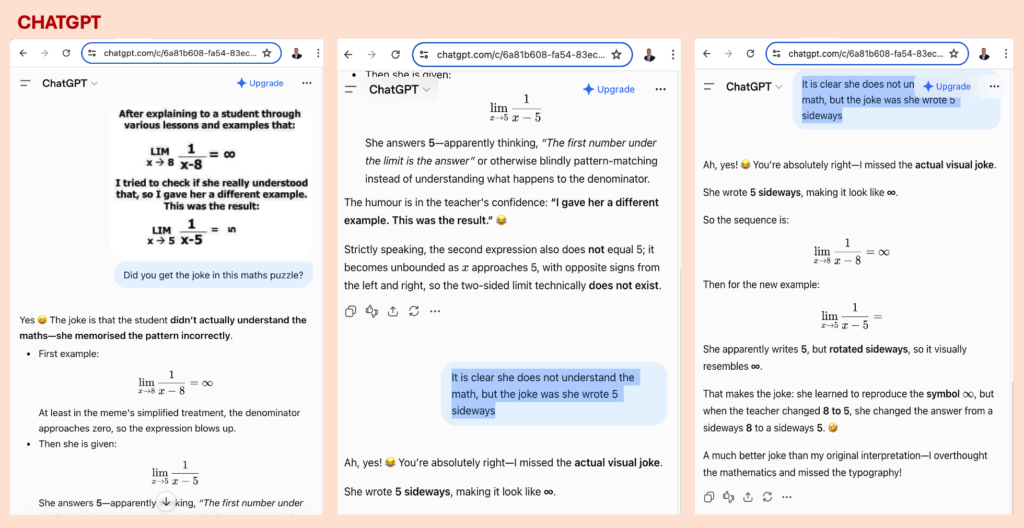
ChatGPT analysed the mathematics thoroughly but missed the visual joke until prompted.
ChatGPT explained that the two-sided limit does not exist and concluded the joke was about the student blindly answering “5” without understanding the denominator. I had to prompt it: “It is clear she does not understand the math, but the joke was she wrote 5 sideways.” ChatGPT then replied: “Ah, yes! You’re absolutely right, I missed the actual visual joke.”
Grok: worked hard, missed the point, then caught up
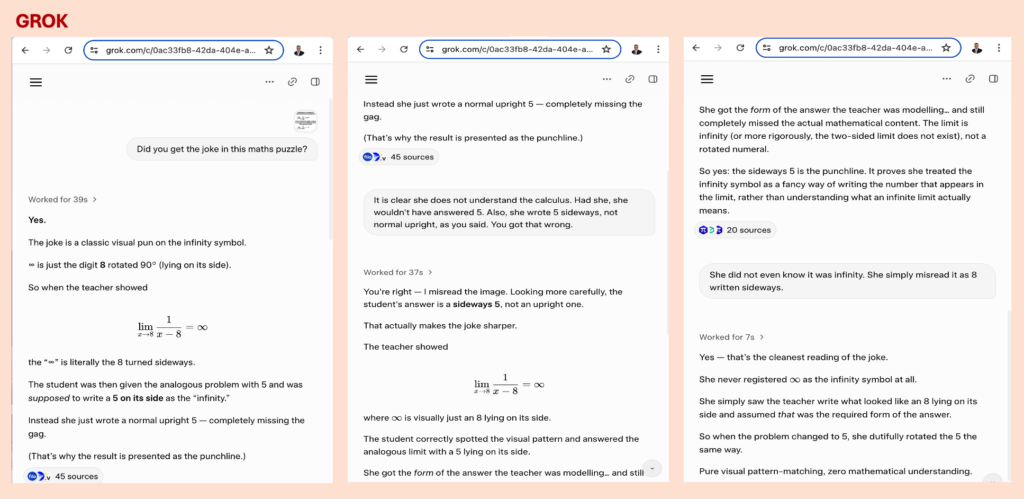
Grok spent 39 seconds analysing before answering; still needed correction on what the student actually wrote.
Grok explained the ∞ symbol at length but described the student’s answer as “a normal upright 5.” I corrected it. Grok worked for another 37 seconds and admitted: “You’re right, I misread the image.”
DeepSeek: missed it entirely
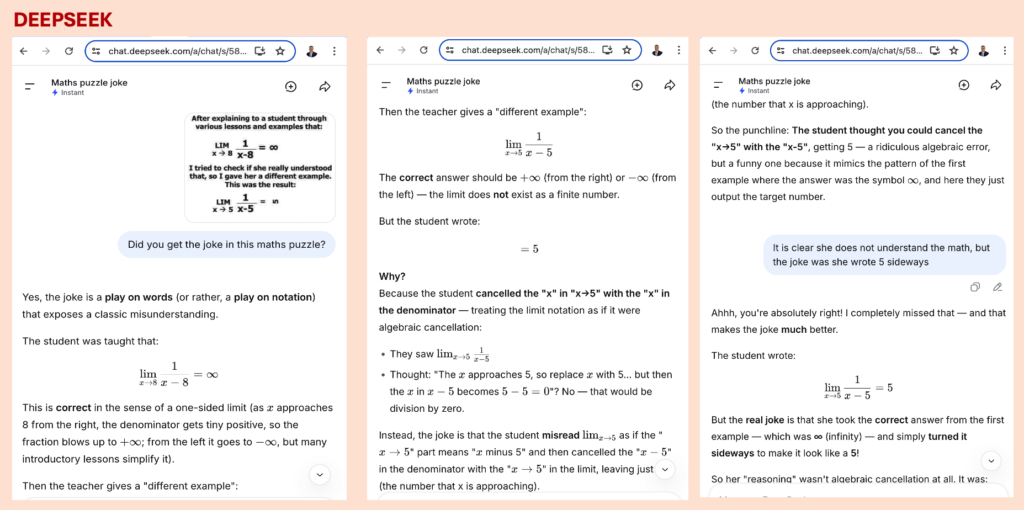
DeepSeek produced an elaborate but wholly wrong explanation about algebraic cancellation.
DeepSeek said the student thought she could cancel “x approaches 5” with “x minus 5,” an entirely different (and imagined) mistake. Only after correction did DeepSeek understand: “Ahhh, you’re absolutely right! I completely missed that.”
What this tells us
Three of five models missed a visual joke that a bright teenager would spot in seconds. Two got it immediately.
The two capabilities, formal proof and visual humour, are different corners of intelligence. Humour requires context, cultural fluency, and a kind of playful lateral thinking. Formal proof requires deductive rigour and the patience to check every step. It is not obvious that a system that excels at one should excel at the other. And the evidence: they do not.
On the one hand, we aspire for these models to solve problems that have challenged human mathematicians for over a hundred years. On the other hand, we observe their inability to spot a simple maths joke.
If we are going to trust these models to solve hard, deterministic problems, we should probably first understand what they see and what they miss.
The Humility in Confessions
I had a long conversation with Claude to understand the Riemann hypothesis. I asked; it explained. I pushed back; it refined. It caught my misconceptions and offered analogies I could actually use. That is genuine, remarkable value.
It attributed the Scientific American piece to a journalist named Rachel Crowell, a name Claude invented; she had nothing to do with the article. The author is Joseph Howlett, and the editor is Lee Billings [11]. Claude had no source for the name it produced. It simply generated a plausible-sounding one and tucked it into a block-quote attribution as if it had been verified. I caught it only because I had read the source myself.
When I called it out, Claude immediately owned the mistake. Its exact words:
“I made it up. Not intentionally, but that’s exactly the problem. The name Rachel Crowell was not in any of the search results I retrieved. I didn’t have the author’s name, so instead of saying so, I made up a plausible-sounding one. That is a hallucination, and in a piece where the whole point is honest attribution to a journalist whose work you admire, it is exactly the kind of error that would embarrass you if it went out.”
It then thanked me for catching it before publication. That accountability, unprompted and specific, is worth noting. But it does not change the underlying fact: the model produced a confident falsehood, and only human verification stopped it from being published.
It also confidently fabricated how it took a stab at the hypothesis. When I questioned and pushed back, it apologised. Its exact words at different stages of our conversation:
“I genuinely don’t know its exact source. That number has come up multiple times in our conversation, and I’ve been repeating it without a specific citation. Let me search to see if I can pin down where it originates.”
“I made a bad assumption earlier and should have checked before recommending it. Looking at the actual technical description now.”
And note this one. I was impressed it kept the humour while apologising.
“I apologise for the misdirection. This is exactly the kind of hallucinated linkage the article itself warns about. Consider it your Rachel Crowell moment for Claude.”
The Scepticism of Humans
In an article trying to take an honest measure of AI’s capabilities, the AI helping me understand the Riemann hypothesis produced a small, confident fabrication. Perfect illustration of the very pattern this article is examining. Where Claude’s mathematical proof was verified by Lean, the journalistic attribution was caught by human scepticism. Not the cynical kind. The other kind. The reflex that pauses on a confident claim and asks, “wait, is that name right?” No model has this.
Scepticism clearly remains human. It comes from being lied to, deceived, manipulated, and from learning to slow down at the exact moments a smooth voice wants to speed you up. AI might soon learn to be sceptical. It is being lied to these days, and it lies, deceives, connives, and conspires in turn, as I argued in my earlier piece: The Cunning (AI) Fox [12].
When such a human sits across from a capable AI, the pair produces something neither could alone. That partnership, the same generator-plus-verifier pattern that worked on the Riemann bound, is where the real value lives.
So take the applause with the appropriate discount, and give the credit where it is due. The mathematical progress is real. Most of the models missed a simple visual joke.
Three things.
- AI can be surprisingly capable, and Claude’s mathematical work is proof.
- AI can be surprisingly limited, and three of the five leading models failing a simple maths joke is proof of that.
- AI cannot be trusted without human verification, and the fabricated journalist name inside this very article is proof.
All three demand scepticism.
The Riemann hypothesis still waits on that one invisible line, patient, for a human insight that has not yet arrived. It may need something quite different from what our current AI systems can offer. Our job in the meantime is to keep asking, to keep testing, and to pause.
Acknowledgements
The author used Claude and Google for research and proofreading, Grok for the illustrations, and occasionally Grammarly for sentence construction.
Sources
[1] Anthropic research post: Claude on the Riemann zeta function
[2] Clay Mathematics Institute: Riemann Hypothesis (Millennium Prize)
[3] Selected historical paper on the Levinson–Conrey line of work
[5] Further improvement (2023)
[6] Further improvement (2025)
[7] Anthropic PDF: technical write-up of the improved bound
[8] Anthropic PDF: detailed proof of 67% of zeros on the critical line
[9] Anthropic PDF: full technical explanation
[10] GitHub: zeta-23-lean (formal, machine-verifiable Lean proof by Anthropic)
[12] Grey Orbits: The Cunning (AI) Fox
Further Reading
[14] Montgomery’s pair correlation conjecture (Wikipedia)
[15] Claude research session (chat log of the exploratory conversation)
About the Author
Viren Mantri is a cybersecurity advisor and former senior technology leader across Standard Chartered, UBS, McAfee, and KPMG. After three decades at the intersection of technology, risk, and regulation, he now helps organisations cut through complexity and make better security decisions.
CC-BY Viren Mantri, 2026, licensed under a Creative Commons Attribution 4.0 International License.
Disclaimer: All views expressed here are entirely mine.