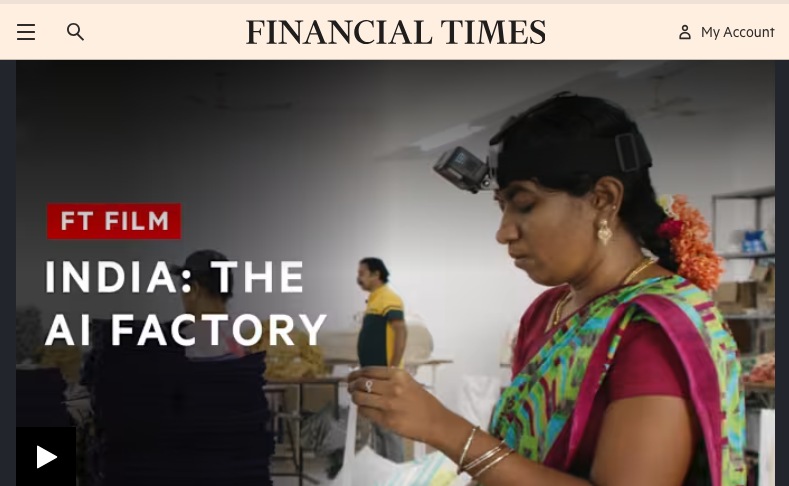
Yesterday, I watched this FT documentary film: The AI factory: the rewiring of India’s tech industry.
What captured my attention: garment workers in a small Tamil Nadu town, wearing cameras strapped to their foreheads for 6 to 8 hours a day, filming their own hands as they stitch, fold, iron, for an additional 10,000 rupees a month, to train robots.
A film I watched 8 months ago, Aranya Sahay’s “Humans in the Loop,” told this same story as fiction (my LinkedIn post then: https://www.linkedin.com/posts/viren-mantri_watch-humans-in-the-loop-netflix-activity-7389995317020188672-O5EC). It seems the reality caught up with it.
Nobody in this chain is doing anything wrong. A business owner is solving a real problem, there are no jobs in these towns. A worker is grateful for the extra income. Everyone’s decision, taken on its own, makes sense.
But step back, and a harder question sits underneath all of it. These workers are teaching machines everything they know, their skill, their years of practice, their hands. And once that knowledge is captured, it belongs to someone else. The worker doesn’t get a share of what it becomes.
None of this raised eyebrows in the documentary. But the techniques used to teach a robot to recognise a cup on a factory floor are the same techniques that teach a system to recognise a face, a gait, a daily routine. Extend that to health records, biometric surveillance, or predictive policing, and this stops being a labour question. It becomes a privacy, sovereignty, and potentially even a criminal-misuse question. Who holds this data, under which jurisdiction, and for what future use, matters as much as who captured it.
There is no clear consent standard for any of this. Workers know they are filmed. What they do not know is where the footage goes, who owns it, or what it eventually builds. There is no data ownership clarity either. They are a one-time input into someone else’s asset.
And why this data, at this scale, right now? Data hunger is being treated as self-justifying, that the industry needs more humans in the loop. The real question is not can we collect this, but what it unlocks, who benefits, and whether the worker has any claim on that value.
Whether such arrangements widen opportunity, or simply push the risk downward, to those least able to negotiate terms or refuse? Not once was this raised in the documentary. It should be debated at policy level, as a test of India’s inclusive growth as a governance goal.
Finally, value capture and value creation are not the same thing. Someone should ask who the AI factory of the world actually serves.
The film had a simple message: “AI is like a child. If we feed it the wrong things, it learns the wrong things.” I’d add to that. If we feed it without asking who’s doing the feeding, and what they get in return, we’ve already decided what kind of world we’re building.
About the Author
Viren Mantri is a cybersecurity advisor and former senior technology leader across Standard Chartered, UBS, McAfee, and KPMG. After three decades at the intersection of technology, risk, and regulation, he now helps organisations cut through complexity and make better security decisions.
CC-BY Viren Mantri, 2026, licensed under a Creative Commons Attribution 4.0 International License.
Disclaimer: All views expressed here are entirely mine.